Is Making Noise “Harassment?” Know Your Rights in the Streets
As ICE activity ramps up in SELA, we’re hearing the same question more often: “If I blow a whistle or yell at an agent, can I be arrested for harassment?”
It’s a common intimidation tactic used by federal agents to cite statutes like 18 U.S.C. § 111 (Assaulting, Resisting, or Impeding an Officer) to get people to stop recording or making noise. But here’s the reality: Verbal criticism and making noise are core First Amendment protections.
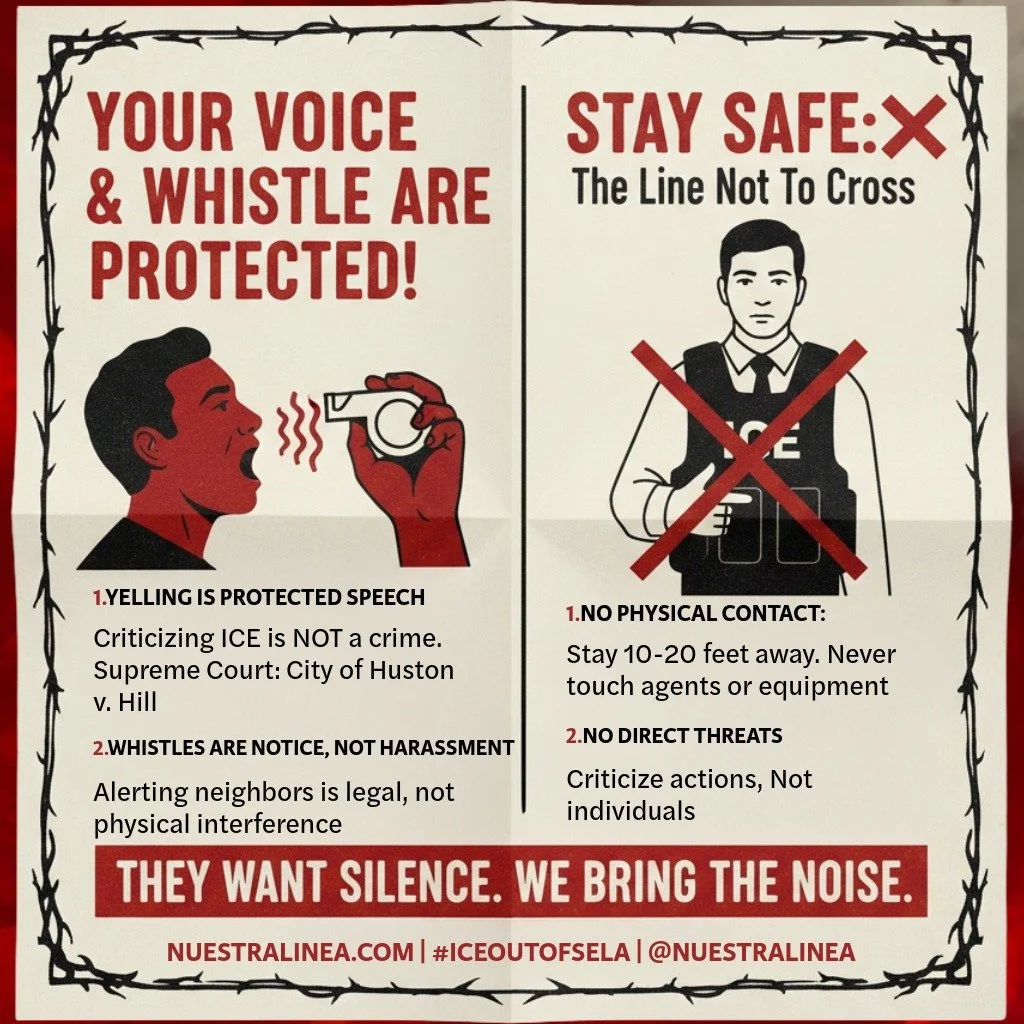
1. Yelling is Protected Speech
The Supreme Court has ruled repeatedly (notably in City of Houston v. Hill) that the First Amendment protects a significant amount of verbal criticism and challenge directed at law enforcement. While "fighting words" that incite immediate violence aren't protected, simply yelling, cursing, or expressing your opposition to an ICE agent’s presence is not a crime.
As the courts have said: "The freedom of individuals verbally to oppose or challenge police action without thereby risking arrest is one of the principal characteristics by which we distinguish a free nation from a police state."
2. Whistles are a Tool of "Notice," Not Harassment
Blowing a whistle to alert neighbors of ICE’s presence is a form of non-violent protest and information sharing. * It is not physical interference: To "impede" or "interfere" in a criminal sense, there usually must be a physical element—like blocking a vehicle or stepping between an agent and a detainee.
It is a warning: Telling your neighbors that agents are in the area is no different from flashing your headlights to warn of a speed trap or posting a sighting on social media.
3. The "Harassment" Myth
Agents may call your yelling or whistling "harassment" because it makes their job harder or more uncomfortable. However, the law does not criminalize behavior simply because it's annoying to a government official. In fact, a federal judge recently rejected the government’s argument that protesters tracking agents were "interfering," noting that documenting and criticizing law enforcement is essential for accountability.
The Line You Shouldn't Cross
While your voice and your whistle are protected, you stay safe by keeping these three rules in mind:
Maintain Distance: Stay at least 10–20 feet back. If you get too close, they can claim you are physically "obstructing" their movement.
No Physical Contact: Never touch an agent or their equipment.
No Direct Threats: Avoid saying you will personally harm them. Stick to criticizing their actions and the system they represent.
The Bottom Line
They want you to move in silence. They want the neighborhood to be quiet so they can operate in the shadows. Blowing a whistle isn't harassment—it's community defense. It’s making sure that in SELA, no one is taken away without the whole block knowing about it.
Stay loud. Stay safe. 📢
Next Step: Would you like me to create a "Know Your Rights" infographic version of this blog post that you can print out and keep at the shop or hand out with the whistles?